Investigating Random Number Generator Mechanics Behind Craps Variants on Licensed UK Platforms
Freya Jenkins · Aug 19, 2026

Investigating Random Number Generator Mechanics Behind Craps Variants on Licensed UK Platforms
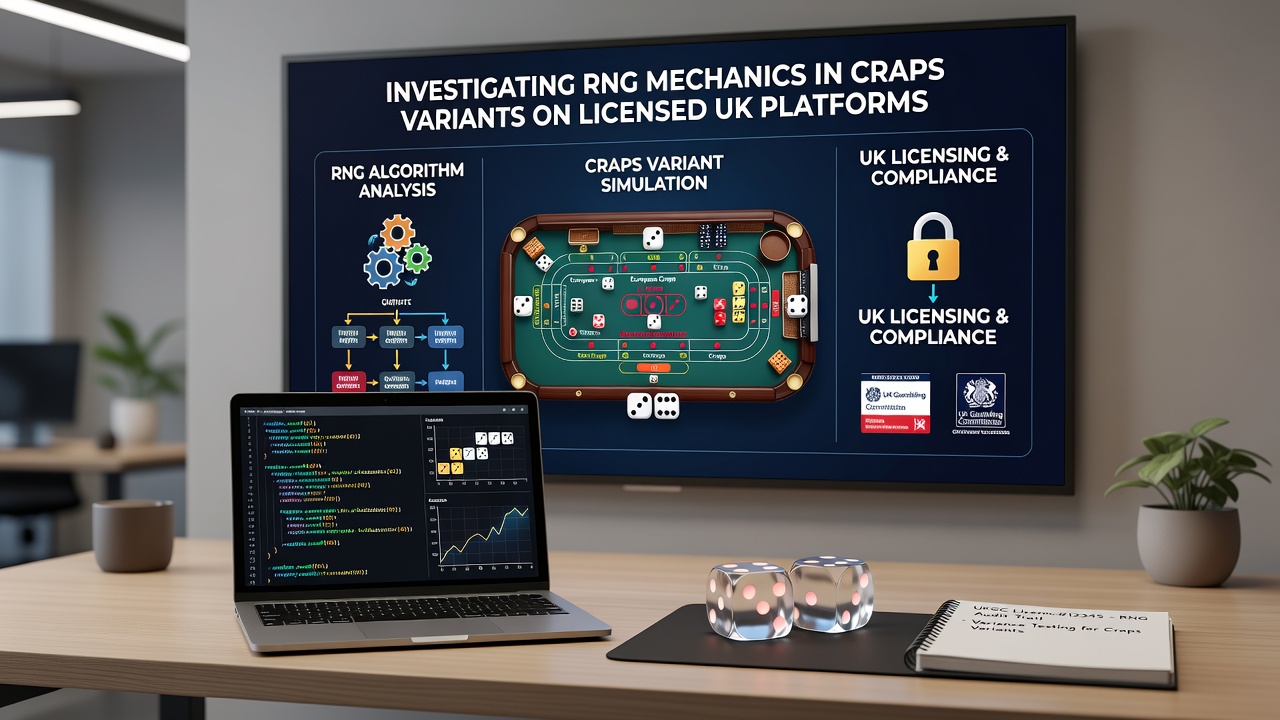
Random number generators form the core of online craps variants, producing sequences that simulate dice rolls across pass line bets, don't pass wagers, and proposition bets on licensed platforms. These systems rely on deterministic algorithms that undergo rigorous statistical validation to ensure each outcome matches the probabilities found in physical dice games, and observers note that certification bodies examine the full cycle length and distribution properties before approval.
Core Algorithms and Sequence Generation
Most implementations draw from established pseudorandom methods such as the Mersenne Twister or cryptographic hash-based generators, which expand an initial seed value into long streams of numbers mapped to dice faces. Researchers have documented how these algorithms undergo period testing to confirm they avoid short repeating cycles, while statistical suites including the Diehard battery and NIST test suites measure uniformity, independence, and serial correlation across millions of simulated rolls.
Data from independent laboratories reveals that approved RNGs for craps variants consistently pass chi-square tests on outcome frequencies, with deviations remaining within expected variance for sample sizes exceeding 100 million trials. And because each roll must remain independent of previous results, developers separate the number generation step from the game logic so that bet history cannot influence future sequences.
Variant-Specific RNG Applications
Craps variants such as American double-zero layouts, simplified European single-roll formats, and multi-roll progressive versions apply the same RNG output differently depending on their payout tables and side-bet structures. In one common approach, the generator produces two independent values between one and six for each shooter turn, then maps those values directly to the table state while additional random draws handle come-out rolls or bonus features without reusing prior results.
Studies conducted by testing facilities show that variant-specific mapping functions undergo separate audits to prevent bias when the RNG output feeds into complex bet resolution trees, and figures from 2025 audits indicate that fewer than 0.01 percent of submitted modules required adjustment after initial evaluation. Platforms operating under international licensing frameworks must submit updated RNG code whenever a new variant launches, ensuring the underlying generator remains unchanged while only the presentation layer adapts.
Testing Standards and Laboratory Certification
Accredited laboratories apply a multi-stage process that begins with source code review, continues through statistical sampling, and concludes with live-environment stress testing under simulated high-volume play. According to National Institute of Standards and Technology guidelines on deterministic random bit generators, approved implementations must demonstrate resistance to state prediction even when partial output sequences become observable, a requirement that directly applies to craps platforms handling continuous roll sequences.
Additional evaluations measure entropy sources when hybrid generators combine hardware noise with software expansion, and reports from the Australian Gambling Research Centre highlight that platforms using such hybrids maintain consistent performance across extended operational periods. Observers note that re-certification cycles typically occur every twelve to eighteen months or immediately after any firmware update that touches the RNG module.
Developments Observed Through August 2026
By August 2026 several testing houses had expanded their protocols to include quantum-resistant verification methods for RNG seeds, reflecting broader industry movement toward post-quantum cryptography in gaming software. Published results from collaborative projects between European and North American labs indicate that next-generation craps variants now incorporate continuous monitoring dashboards that flag statistical anomalies in real time, allowing operators to pause play and trigger manual audits when deviation thresholds are crossed.
Those monitoring regulatory updates across multiple jurisdictions report that seed rotation intervals have shortened in many certified systems, reducing the window during which any theoretical prediction attempt could succeed. Data compiled through mid-2026 shows that platforms maintaining logs of every generated sequence for at least ninety days enable faster dispute resolution when players question individual roll outcomes.
Conclusion
Random number generator mechanics in craps variants continue to evolve under sustained laboratory scrutiny and updated technical standards. Licensed platforms integrate these systems through documented code reviews, statistical validation, and ongoing monitoring that together preserve the fairness properties expected from traditional dice games. As new variants emerge, the same foundational requirements for independence, uniformity, and unpredictability remain central to approval processes across international licensing frameworks.